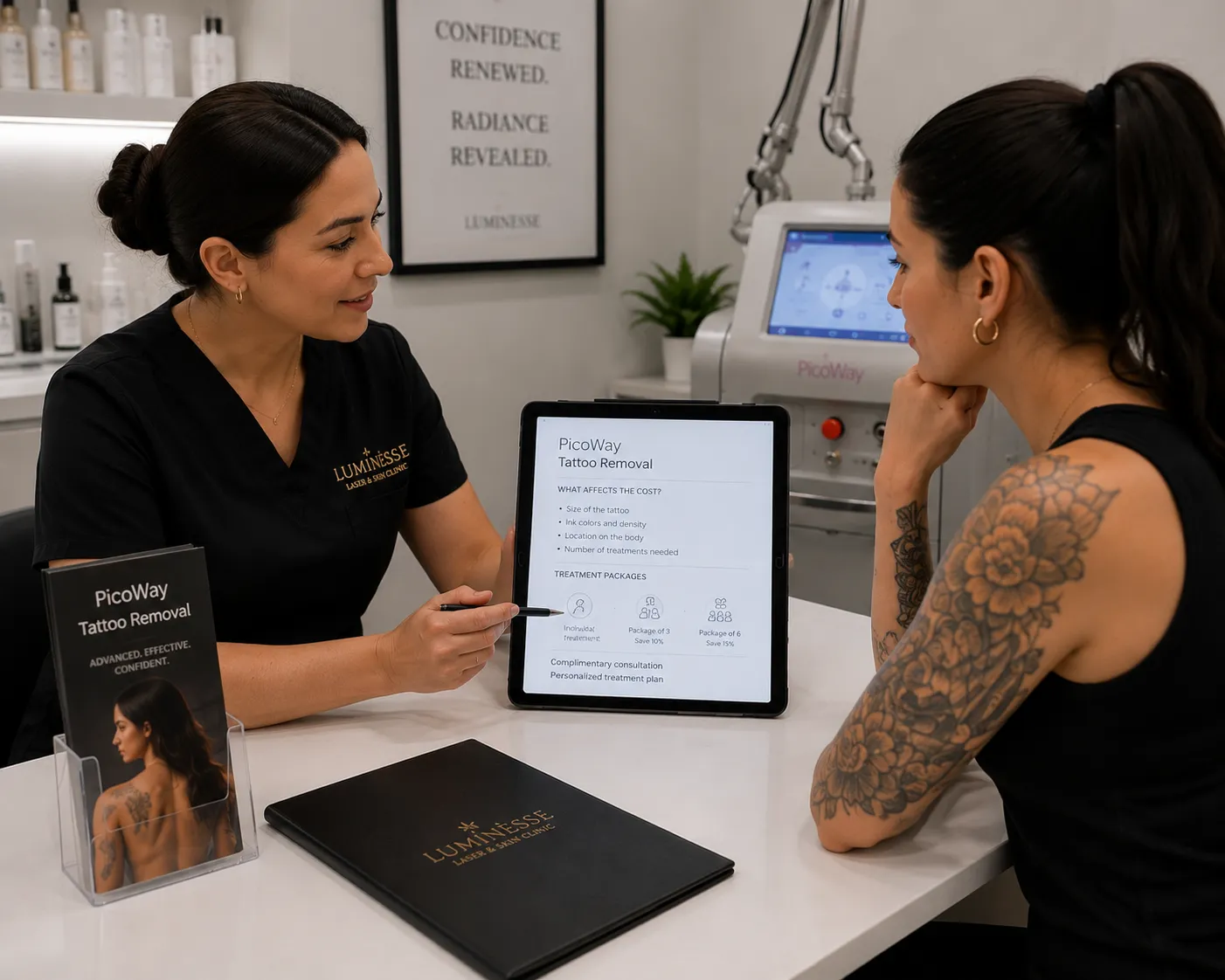
Most tattoos require 6 to 12 PicoWay laser sessions, spaced 6 to 8 weeks apart. The Kirby-Desai scale estimates this range by scoring skin type, location, color, ink amount, scarring, and layering. Ottawa clients at Luminesse Laser tattoo removal services receive a free consultation to determine their precise treatment plan and cost.
Estimating Your Tattoo Removal Journey
Laser tattoo removal requires a personalized clinical assessment, not a generic session count. The number of treatments needed varies dramatically based on specific tattoo characteristics and individual physiological responses. LaserAway explains that how many laser tattoo removal sessions a client needs depends on many variables: a tattoo’s size, colors, location, age, ink density, and skin type. No single estimate applies universally.
Why do session estimates vary so widely?
Tattoo ink composition differs between professional and amateur applications. Professional tattoos often contain denser, deeper pigment deposits. Amateur tattoos typically use less ink with inconsistent depth. The body’s immune response also influences clearance speed. Lymphatic function, circulation at the tattoo site, and overall health affect how quickly shattered ink particles are eliminated.
What clinical factors determine pigment clearance?
The Kirby Desai scale tattoo removal assessment tool scores six parameters to estimate treatment needs. These include skin type, tattoo location, ink colors, ink density, scarring, and layering. A tattoo on the upper chest clears faster than one on the ankle due to superior blood supply. Black ink responds most readily to laser energy. Green and blue pigments prove more resistant. Older tattoos often fade faster because the body has already begun breaking down ink particles over time.
The effectiveness of laser tattoo removal depends on several factors, including the size, color, and age of the tattoo, as well as the type of laser used. Advanced laser options like picosecond lasers deliver ultra-short pulses that shatter ink into microscopic fragments. Luminesse Laser & Skin Clinic provides advanced picosecond tattoo removal using the Candela PicoWay platform, which employs PicoWay laser technology with multiple wavelengths to target diverse ink colors across all skin types.
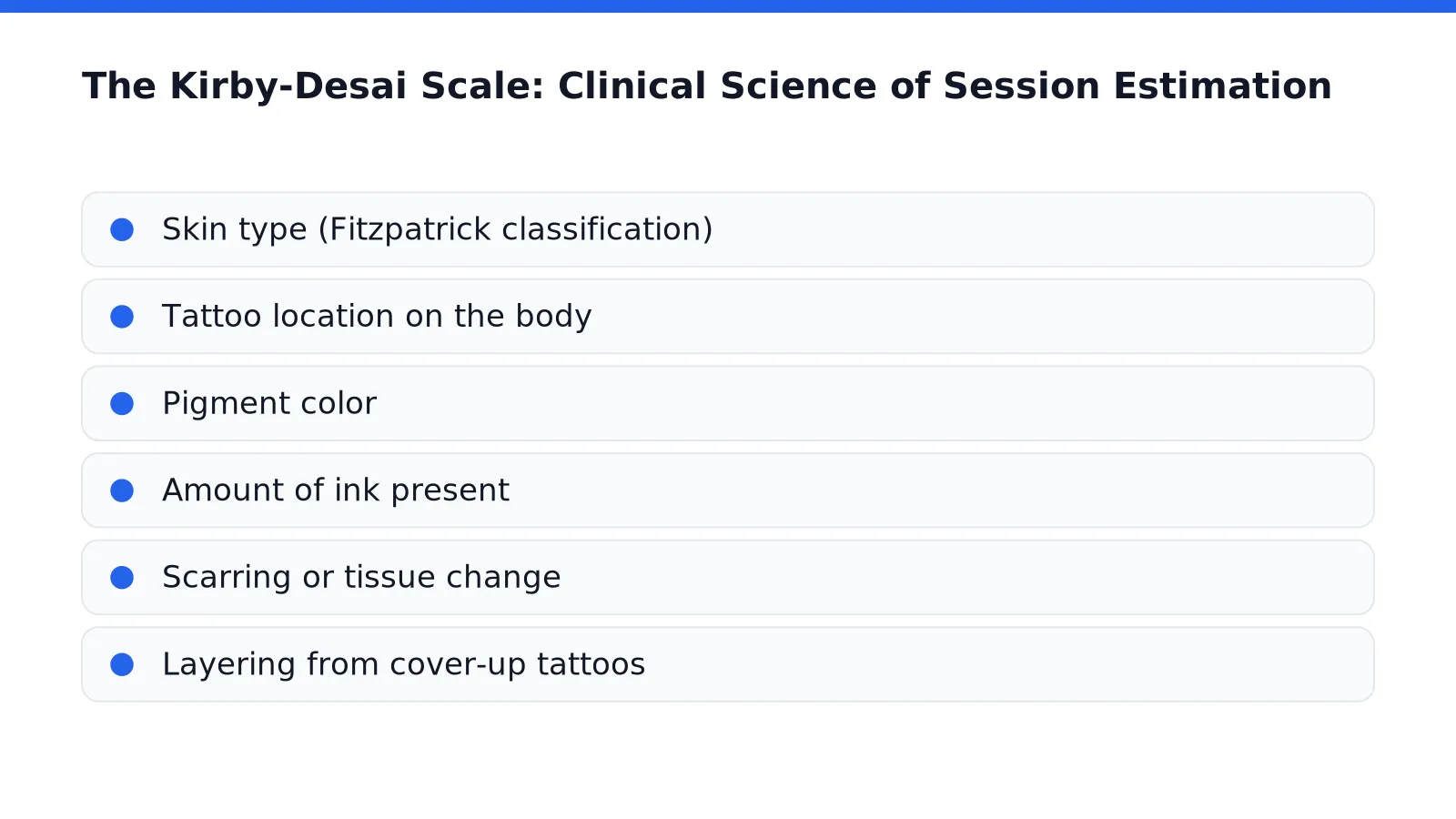
The Kirby-Desai Scale: Clinical Science of Session Estimation
The Kirby-Desai scale for tattoo removal provides a structured clinical method for estimating treatment sessions. Developed by Dr. Will Kirby and Dr. Alpesh Desai, the scale scores six parameters to predict how many laser sessions a tattoo requires.
The six scored parameters are:
- Skin type (Fitzpatrick classification)
- Tattoo location on the body
- Pigment color
- Amount of ink present
- Scarring or tissue change
- Layering from cover-up tattoos
Each parameter receives a point value. The total score ranges from 4 to 26. A score of 10 points to approximately 10 sessions, spaced 6 to 8 weeks apart. Ottawa clients considering removal benefit from understanding this framework before a consultation.
How does the Kirby-Desai score translate to session counts?
The total score tracks the predicted number of sessions. Lower scores indicate fewer treatments. Higher scores signal more complex removals requiring extended timelines.
What factors increase a Kirby-Desai score in Ottawa?
Darker ink density, professional application depth, and tattoos on extremities with limited blood supply raise scores. Layered cover-ups and existing scar tissue also add points. These variables extend the picoway vs traditional q switched lasers healing timeline between sessions.
Picosecond Technology Factor: How Candela PicoWay Modifies the Equation
The Candela PicoWay platform changes laser tattoo removal through pure photoacoustic energy. Traditional lasers rely on heat to break down ink. PicoWay uses ultra-short pulses that create mechanical shockwaves instead. These shockwaves shatter ink particles into microscopic dust-like fragments without thermal damage to surrounding tissue. The result is faster clearance and less trauma to the skin.
How does picosecond technology reduce the number of sessions needed?
Picosecond tattoo removal in Ottawa reduces Kirby-Desai predicted sessions compared to traditional lasers. A tattoo that might require more sessions with older technology often clears in fewer sessions with PicoWay. Most patients require 3 to 12 sessions total to reach their desired results. The Kirby Desai scale tattoo removal estimates become far more favorable when picosecond energy enters the equation.
What ink colors and skin types does PicoWay treat effectively?
The platform utilizes four wavelengths: 532 nm, 730 nm, 785 nm, and 1064 nm. This multi-wavelength capability targets all major ink colors including black, blue, green, and red. Treatment remains safe and effective across all Fitzpatrick skin types I through VI. Ottawa residents with darker skin tones face none of the burn risks common with older laser systems. The photoacoustic mechanism minimizes epidermal thermal damage, targeting ink particles deep beneath the skin’s surface.
Laser Tattoo Removal Costs in Ottawa: Transparent Pricing Breakdown
Laser tattoo removal cost Ottawa clinics charge varies by session, with single treatments at comparable providers typically ranging from $200 to $500. Removery reports this range depends on tattoo size, location, colors, and complexity. Tattoo removal pricing Ottawa residents encounter reflects several clinical variables rather than a flat rate.
What factors determine the price per session?
PicoWay tattoo removal cost depends on tattoo size, color, ink density, and expected outcome. Most patients require multiple sessions to achieve clearance. Pricing for PicoWay treatments varies by provider and tattoo dimensions.
How do per-session costs compare to package pricing?
Clinics offer two primary pricing models. Per-session payments suit clients fading a tattoo for a cover-up or those not ready to commit to a full removal package. Treatment packages reduce the per-session rate for clients needing a complete series. The total investment with advanced picosecond technology often proves lower than with older lasers requiring double the sessions.
Tattoo surface area directly shapes cost. Clinics categorize tattoos as extra small, small, medium, large, or extra large. A small wrist tattoo costs less per session than a full back piece. Luminesse Laser & Skin Clinic provides advanced picosecond tattoo removal using the Candela PicoWay platform. Clients exploring Ottawa tattoo removal costs benefit from understanding these size-based tiers before booking a consultation.
The Healing Timeline & What to Expect After Each Session
Laser tattoo removal triggers a predictable biological response in Ottawa clients. The picoway tattoo removal healing timeline follows distinct phases as the body clears fragmented ink.
The procedure uses high-intensity light to break down tattoo ink, which the lymphatic system then absorbs. Short laser pulses shatter ink particles into smaller fragments. The immune system eliminates these fragments naturally over several weeks.
What Happens Immediately After Treatment?
Clinical frosting appears within minutes. The treated area shows a white, chalky discoloration caused by carbon dioxide release. Mild edema, or swelling, develops as the skin responds to the laser energy.
What Should Clients Expect During the First Week?
Days 1 through 7 bring visible skin recovery. Crusting and peeling occur as the epidermis repairs itself. Clients in Ottawa should avoid picking at any scabs to prevent scarring.
How Long Does Full Ink Clearance Take?
Sessions are typically spaced 6 to 8 weeks apart. This interval allows the body to process shattered ink between treatments. Weeks 2 through 8 involve lymphatic drainage and macrophage activity, where immune cells transport pigment away from the treatment site.
Tattoo removal aftercare tips during this window include gentle cleansing and sun protection. The healing process repeats with each session until the tattoo fades completely.
Essential Aftercare Protocols for Maximum Clearance
Effective tattoo removal aftercare tips determine how completely ink clears and how smoothly skin heals. Post-treatment protocols protect the dermis during the critical window when the body’s lymphatic system flushes shattered pigment particles. Skipping these steps compromises results and risks permanent textural damage.
What should clients do immediately after a PicoWay session?
The clinic applies post-treatment cooling to calm the treated area. Gentle cleansing removes surface debris without disrupting the skin barrier. A thin layer of medical-grade ointment seals the site against bacteria while maintaining the moist environment essential for re-epithelialization. Most people describe the sensation of laser tattoo removal as similar to tiny pinpricks or the snapping of a rubber band against the skin, and this mild discomfort typically subsides within hours.
How does sun exposure affect tattoo removal results?
Sun avoidance remains the single most critical variable in the Picoway tattoo removal healing timeline. Clients must avoid sun and tanning for two full weeks before and after each laser session. UV radiation triggers melanocyte hyperactivity in healing tissue, producing stubborn post-inflammatory hyperpigmentation that obscures the treatment field and delays subsequent sessions. Daily application of mineral SPF 30+ blocks the specific wavelengths that destabilize recovering skin. Heat sources, saunas, and friction from tight clothing must also be avoided for 24 to 48 hours post-treatment.
What daily habits accelerate ink clearance?
Hydration drives the lymphatic transport that carries fragmented ink particles away from the dermis. Consistent water intake paired with moderate physical activity increases circulation and metabolic clearance rates. Clients who maintain these habits between sessions often see faster fading and fewer total treatments required.
Book Your Consultation & Kirby-Desai Assessment in Ottawa
A consultation at Luminesse Laser & Skin Clinic begins with a structured Kirby-Desai Scale tattoo removal assessment. This clinical scoring system, developed by Dr. Will Kirby and Dr. Alpesh Desai, estimates the number of treatments a tattoo requires. The scale evaluates six parameters: skin type, tattoo location, ink colors, ink density, scarring, and layering. Each factor receives a point value. The total score, ranging from 4 to 26, correlates directly with the projected session count. A score of 10 suggests approximately 10 sessions spaced 6 to 8 weeks apart.
What happens during the Kirby-Desai evaluation?
The clinician examines the tattoo under specialized lighting. Skin type is classified using the Fitzpatrick scale. Tattoo location is scored by blood and lymphatic supply, with areas like the neck and face clearing faster than the hands or feet. Ink colors are catalogued, as darker pigments respond more readily to laser energy. The amount of ink, any existing scar tissue, and whether the tattoo is a cover-up all contribute to the final score. This objective framework replaces guesswork with a data-driven treatment roadmap.
Conclusion
The Kirby-Desai Scale transforms tattoo removal from guesswork into a predictable process. Ottawa clients who book a consultation receive a session estimate grounded in their specific skin type, ink colors, and tattoo characteristics. This assessment eliminates uncertainty and provides a clear path forward. Understanding the required session count allows clients to plan their investment and timeline with confidence, making the decision to begin treatment straightforward rather than overwhelming.
Luminesse Laser & Skin Clinic operates from 106 Colonnade Road North, Suite 230, in Nepean, Ontario. The location serves residents across Ottawa, Kanata, Barrhaven, and Gatineau. Bilingual consultations are available in English and French. Clients schedule appointments through 24/7 online booking via Vagaro, or by calling +1 613-727-0714. The clinic’s address and contact details remain consistent across all communications, ensuring straightforward access for anyone seeking a Kirby-Desai assessment in the National Capital Region.

